Cambridge IELTS 12 is the latest IELTS exam preparation. READINGIELTS.COM will help you to answer all questions in cambridge ielts 12 reading test 5 with detail explanations.
Passage 1: Cork
Questions 1-5: Do the following statements agree with the information given in Reading Passage 1?
1. The cork oak has the thickest bark of any living tree.
Key words: thickest bark
In paragraph 1 and paragraph 2, the author mentioned the thick bark of the cork oak tree as “a remarkable material” and “its bark grows up to 20 cm in thickness”. This information does not mean that it is “the thickest bark of any living tree”.
In addition, in True/ False/ Not given tasks, the questions follow the order of the text, so if you are not sure about your answer, you can find the answer to question 2. It is in the second sentence of paragraph 2. Therefore, you just need to pay attention to the previous parts. There is no statement showing any comparison between the cork oak’s bark with that of other living trees. We have no information about this statement.
Answer: NOT GIVEN
2. Scientists have developed a synthetic cork with the same cellular structure as natural cork.
Key words: a synthetic cork, the same cellular structure, natural cork
In paragraph 2, the writer mentioned the cellular structure of the bark of the coak oak “the bark of the cork oak has a particular cellular structure – with about 40 million cells per cubic centimetre – that technology has never succeeded in replicating”. The technology can refer to the scientists here. The fact that they “never succeeded in replicating” means that they have not been able to make a copy of the natural cork, with all of the same qualities. So the answer is False.
• Develop with the same structure = replicate
Answer: FALSE
3. Individual cork oak trees must be left for 25 years between the first and second harvest.
Key words: individual, 25 years, the first and second harvest
In paragraph 4, the author mentioned the harvesting of an individual cork oak tree. He/she wrote “From the planting of a cork sapling to the first harvest takes 25 years, and a gap of approximately a decade must separate harvests from an individual tree”. Therefore, the period of 25 years is the period from the planting to the first harvest, while the gap between the first and the second harvest is about 10 years (approximately a decade).
• Between = gap
• The first and second harvest = separate harvests
Answer: FALSE
4. Cork bark should be stripped in dry atmospheric conditions.
Key words: stripped, dry atmospheric conditions
We need to find information about the cork bark being stripped. Following the order of the text, we can see in the paragraph 4, the author mentioned “If the bark is stripped on a day when it’s too cold – or when the air is damp – the tree will be damaged”. Therefore, the bark should not be stripped in damp atmospheric conditions; however, in contrast, it should be stripped in dry atmospheric conditions. The answer is True.
• The air = atmospheric conditions
Answer: TRUE
5. The only way to remove the bark from cork oak trees is by hand.
Key words: only way, remove, by hand
In paragraph 5, the author claimed “No mechanical means of stripping cork bark has been invented, so the job is done by teams of highly skilled workers.” In this sentence, “stripping cork bark” means “remove the bark”. Since the author stated that “no mechanical means has been invented”, we can understand that they do not use any machines in removing the bark, so it has to be done by hand (the hands of highly skilled workers). The answer is True.
Remove = strip
By hand = done by workers, no mechanical means
Answer: TRUE.
Questions 6-13: Complete the notes below. Choose ONE WORD ONLY from the passage for each answer.
6. do not affect the …of the bottle contents
Key words: affect, bottle contents
The author mentioned “Recent years have seen the end of the virtual monopoly of cork as the material for bottle stoppers, due to concerns about the effect it may have on the contents of the bottle…..The tiniest concentrations – as little as three or four parts to a trillion – can spoil the taste of the product contained in the bottle. The result has been a gradual yet steady move first towards plastic stoppers and, more recently, to aluminium screw caps.” It means that aluminium screw caps overcame one disadvantage of cork bottle stoppers, which isthatthey“spoil the taste of the product contained in the bottle”. Therefore, aluminim screw caps do not affect the taste of the product inside the bottle.
The answer is “taste”.
• Affect = spoil
• Bottle contents = the product contained in the bottle
Answer: taste
7. are ________ to produce; Keyword: produce
8. are _______ to use; Key word: use
In the last sentence of paragraph 6, “These substitutes are cheaper to manufacture and, in the case of screw caps, more convenient for the user”. “These substitutes” refer to “aluminium screw caps” and “Manufacture” refers to “produce”, while “for the user” means “to use”. So they are cheaper to produce and more convenient for the user. But thequestion requires “one word only”, so the answer for question 8 has to be “convenient”.
- Produce = manufacture
- To use = for the user
Answer: 7. Cheaper – 8. Convenient.
9. Suit the ______ of quality products
Key words: suit, quality products
We find information about quality products in this sentence: “Firstly, its(the cork bottle stopper) traditional image is more in keeping with that of the type of high quality goods with which it has long been associated”. “in keeping with” means “suit”. So the blank has to be “traditional image”, but the answer allows one word only, so it has to be “image”
• Products = goods
• In keeping with = suit
Answer: image
10. made from a … material
Key words: made from, material
11. easily …
In the next sentence, the write mentioned “Secondly – and very importantly – cork is a sustainable product that can be recycled without difficulty”. Recycling often is associated with the material. So the author is referring to its material here. The answer is “sustainable” and “recycled”
• Easily = without difficulty
Answer: 10. Sustainable – 11. Recycled
12. cork forests aid …; Key words: cork forests, aid
13. cork forests stop … happening; Key words: cork forests, stop
The last sentence mentioned the cork forests – “Moreover, cork forests are a resource which support local biodiversity, and prevent desertification in the regions where they are planted. So, given the current concerns about environmental issues, the future of this ancient material once again looks promising”. “Support” means “aid” and “prevent” is equal to “stop”. So the answers have to be “biodiversity” and “desertification”
aid = support
stop = prevent
Answer: 12. Biodiversity – 13. Desertification.
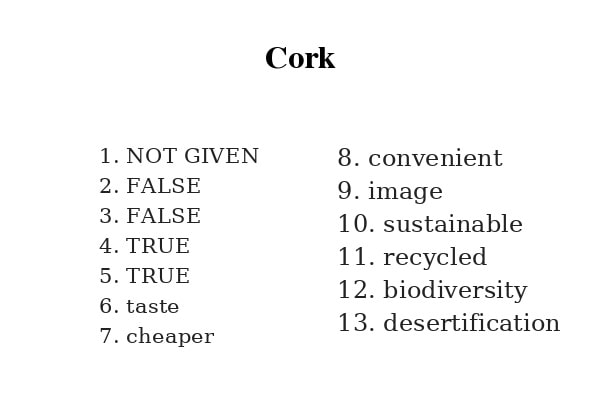
CAMBRIDGE IELTS 12 – TEST 5 – PASSAGE 1 KEYWORDS TABLE
Passage 2: Collecting as a hobby
Questions 14-21: Complete the sentences below. Choose ONE WORD ONLY from the passage for each answer.
14. The writer mentions collecting …as an example of collecting in order to make money.
Key words: collecting, make money
In the first sentence of paragraph 2, the author mentioned “There are the people who collect because they want to make money – this could be called an instrumental reason for collecting; that is, collecting as a means to an end.” With this statement, he/she refered to one purpose of collecting, that is making money. We will look for the next sentence to find out its example – “They’ll look for, say, antiques that they can buy cheaply and expect to be able to sell at a profit.” He/she used antiques as an example of one object that is able to be collected to make money. Therefore, the answer is “antiques”.
Because = in order to
Answer: antiques.
15. Collectors may get a feeling of … from buying and selling items.
Key words: collectors, feeling, buying and selling
In paragraph 2, there is a sentence mentioning buying and selling items, that is: “But there may well be a psychological element, too – buying cheap and selling dear can give the collector a sense of triumph”. “A sense of” means “a feeling of”. So the answer is triumph.
• A sense of = a feeling of
Answer: triumph
16. Collectors’ clubs provide opportunities to share…
Key words: collectors’ clubs, share
In the first sentence of paragraph 3, the author mentioned “a group of collectors” – “attending meetings of a group of collectors and exchanging information on items.” We can consider these groups as “collectors’ clubs”. While attending those clubs, they can exchange information on items. But the question requires one word only, so we choose the most important word – “information”.
• A group of = a club
• Exchange = share
Answer: information
17. Collectors’ clubs offer…with people who have similar interests.
Key words: Collectors’ clubs, similar interests.
This question still mentions “collectors’ clubs” as in the question above, so we still pay attention to paragraph 3. In the second sentence, we see the phrase “like – minded people”. This phrase has the same meaning as “people who have similar interests”. And those clubs bring them into “contact” with other collectors, so the answer is “contact”. “Attending meetings” in clubs is one way in which collectors come into contact socially. (Note: you can make an adjective by a combination which is Adj + N + Ed, such as Grey-haired,
one-eyed, strong-minded and kind-hearted).
• Bring = offer
• People who have similar interests = like – minded people.
Answer: contact/meetings.
18. Collecting sometimes involves a life-long … for a special item.
Key words: collecting, life – long, special item.
Since the questions in IELTS Reading often follow the text’s order, we just need to look at the following sentences and find the similar words to the question we are doing. In the last sentence of paragraph 3, we can see another purpose of collecting – it is “the desire to find something special” (= special item). But the author does not mention something like “life-long”, so we have to continue reading to find the accurate answer. Fortunately, in the next sentence, the author writes “Some may spend their whole lives in a hunt for this” (“the whole lives = life – long”). We can understand that the writer wants to say “Collectors sometimes have a life-long desire/ spend their whole lives in a hunt for a special item.” The answer can be “desire” or “hunt”.
• Whole lives = life- long
Answer: hunt/desire
19. Searching for something particular may prevent people from feeling their life is completely …
Key words: searching, prevent, their life.
In paragraph 4, the author writes “Some may spend their whole lives in a hunt for this (=the special item referred to in paragraph 3). Psychologically, this can give a purpose to a life that otherwise feels aimless .” “This” means “spend their whole lives in a hunt for a special item”. We can understand “a hunt” = “searching for”. The author claims if they are not searching for a special item, they will feel “aimless”. Therefore, the answer is “aimless”. Then, we are told, if the collector finds that special item, they may then “feel empty”, because the search has ended.
• A hunt for = searching for
Answer: aimless/empty
20. Stamp collecting may be…because it provides facts about different countries.
Key words: stamp collecting, facts, different countries.
This question mentions “stamp collecting” as the main subject, so we have to find part of the passage which contains information about this type of collecting – paragraph 5. In this paragraph, the author writes “If you think about collecting postage stamps another potential reason for it – or, perhaps, a result of collecting – is its educational value. Stamp collecting opens a window to other countries, and to the plants, animals, or famous people shown on their stamps.” He/ she mentions the educational value of stamp collecting as it “opens a window to other countries” with things shown on their stamps. The answer is “educational”.
Answer: educational
21…tends to be mostly a male hobby.
Key words: male hobby.
We have to find the paragraph mentioning something related to “male”. In paragraph 7, the author mentions “trainspotting” as “a popular form of collecting, particularly among boys and men” (“In the past – and nowadays, too, though to a lesser extent – a popular form of collecting, particularly among boys and men, was trainspotting.”). The answer is “trainspotting”.
– Boys and men = male
Answer: trainspotting
Questions 22-26: Do the following statements agree with the information given in the reading passage?
22.The number of people buying dolls has grown over the centuries.
Keywords: the number of, buying dolls, grown.
We have to find every part of the text about “dolls”. The whole of paragraph 8 is about this topic. But it is about the things which interest doll collectors, but there is no information about the number of people buying dolls. Therefore, the answer is Not given. (Note: If you are not sure enough, you can try doing the next question. Since the questions are in order, if you find out the sentence for the answer of next question, then the following sentences will not have the answer for this question)
Answer: Not given.
23. Sixteenth century European dolls were normally made of wax and porcelain.
Keywords: 16th century, made of, wax and porcelain.
In the same paragraph about dolls: “Similarly, people who collect dolls may go beyond simply enlarging their collection, and develop an interest in the way that dolls are made, or the materials that are used. These have changed over the centuries from the wood that was standard in 16th century Europe, through the wax and porcelain of later centuries, to the plastics of today’s dolls.” Therefore, in 16th century, European dolls were often made of wood. And the wax and porcelain dolls were popular in later centuries, which means the 17th century and the ones after. The answer is False.
Materials that are used = made of
Answer: False.
24. Arranging a stamp collection by the size of the stamps is less common than other methods.
Keywords: arranging, by the size, less common.
We have to pay attention to paragraph 9, which contains information about arranging a stamp collection. In this paragraph, the author only mentions the reason why some collectors like to arrange their collection and the types of arrangement. There is no reference to what kind of arrangement is more or less popular. Therefore, the answer is Not Given.
Answer: Not given.
25. Someone who collects unusual objects may want others to think he or she is also unusual.
Keywords: unusual objects, think.
In paragraph 10, the author claims “One reason, conscious or not, for what someone chooses to collect is to show the collector’s individualism”, and gives an example when someone collects something unexpected (which means unsual objects), they may be conveying their belief (which means they want others to think) that they are interesting as well. The answer is True.
Unusual = unexpected
Answer: True.
26. Collecting gives a feeling that other hobbies are unlikely to inspire.
Keywords: other hobbies, inspire
In the last paragraph, there is a sentence that is “More than most other hobbies, collecting can be totally engrossing, and can give a strong sense of personal fulfillment.” This means collecting needs all your attention and makes you completely satisfied,while most other hobbies could not do the same (more than most other hobbies). The answer is True.
- Give a sense = give a feeling
- Inspire = fulfil
Answer: True.
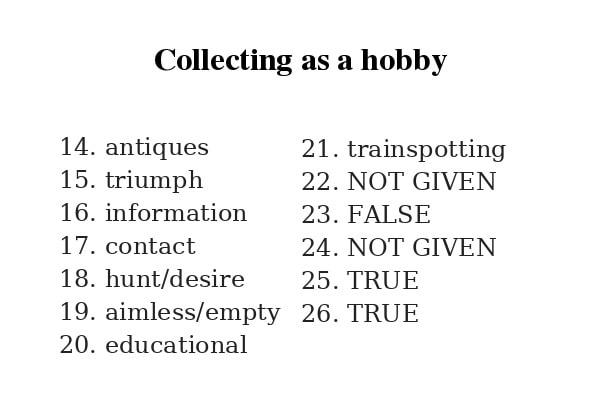
CAMBRIDGE IELTS 12 – TEST 5 – PASSAGE 2 KEYWORDS TABLE
Passage 3: What’s the purpose of gaining knowledge?
Questions 27-32: Reading Passage 3 has six sections, A-F. Choose the correct heading for each section from the list of headings below.
27. Section A
In section A, the author mentions the idea of the founding of a special institution, its possible majors and possible titles for a wide variety of courses. Therefore, we should pay attention to headings related to those contents – they are ii, vi and vii (headings about the title, there is no heading about the other contents). In section A, the author writes “But what would the founders of these two institutions have thought of a course called Arson for Profit’?”. The author adds: “I kid you not…” to explain that this course title is not a joke. We might not expect this course to exist, but it does exist. This is only one unexpected title, so it cannot be “vii” (different names) and the author does not mention anything related to its meanings, so it cannot be ii (with two meanings). The answer is vi.
Answer: vi
28. Section B
Section B is about targeting students of the course because of the opening: “the course is intended for prospective arson investigators”. Then the author asks a question: “But wouldn’t this also be the perfect course for prospective arsonists to sign up for?” in order to point out the possibility of attracting the wrong kind of student. The course might attract students interested in starting fires, not fighting fires. Therefore, the answer is viii.
Answer: viii.
29. Section C
Section C tells us about the author and his story about the title of the course. There are 2 remaining headings that could be related to a title – ii and vii. Since, in this section, the author only mentions one confusing title that could be understood by his students in two different ways, because of the the two meanings of ‘principles’, therefore the answer has to be “a course title with two meanings”. The answer is ii.
Answer: ii
30. Section D
Section D is a very short paragraph. You can look at all the headings and cross out the ones you know are wrong for sure. For example, in section D the author does not mention any course or commitment, so the heading cannot be i – “Courses that require a high level of commitment”. Do the same with other headings, you can find out that only heading iv – “Applying a theory in an unexpected context” still remains. The theory referred to is the idea of the philospher Kant that any body of knowledge is principled. The author writes that this sounds “downright crazy in the light of the evidence”, which has the same meaning as “an unexpected context” when applied to an unethical practice like marketing. The answer is iv.
Answer: iv.
31. Section E
èIn this section, the author mentions two terms in marketing, means and end, in conclusion, he supposes that “A field of knowledge or a professional endeavor is defined by both the means and the end; hence both deserve scrutiny”, which means that both terms are equally important. Therefore, the answer is “the equal importance of two key issues” (iii) “how to achieve X and what X is”.
Answer: iii
32. Section F
In this section, the author gives the example of a doctor and a murderer. Both may learn the same body of knowledge, but they apply that knowledge for different purposes/ends. We give different names: we say that the doctor is practicing medicine and we say that the other is practicing murder. The author does not mention anything related to “a high level of commitment” (heading i) and “financial benefits” (heading v). Therefore, the most accurate heading for this section is “Different names for different outcomes” (vii). The doctor and the murderer use “identical knowledge to achieve their divergent ends”.
Different = divergent
Outcomes = ends
Answer: vii.
Question 33-36:Complete the summary below.Choose NO MORE THAN TWO WORDS from the passage for each answer.
33. […] who are studying …
In the last sentence of the first section, the author writes: “Any undergraduates who have met the academic requirements can sign up for the course in our program in ‘ fire science ’.” Therefore, students who can sign up for the course are undergraduates and ones who are studying “fire science”. The answer is “fire science” (the question requires no more than two words so this is acceptable).
Answer: fire science.
34. […] will become ….
The first sentence of the second section states: “Naturally, the course is intended for prospective arson investigators”. We can see expectation = prospective, which means they are studying to be arson investigators in the future (arson as an adjective = specialising in arson – who specialize in arson). The answer is investigators.
Expectation = prospective
Answer: investigators.
35. […] find …of criminal intent
“The course will help them” means students can learn from the course, so we pay attention to this reference in section B: “who can learn all the tricks of the trade for detecting whether a fire was deliberately set, discovering who did it, and establishing a chain of evidence for effective prosecution in a court of law.” “A fire was deliberately set” can be considered as an example of criminal intent – the arsonist deliberately intended to start a fire. Then the course can help them to detect whether it is deliberate or not, who did it and find a chain of evidence. Therefore, the answer is “evidence”. Find = detect
Answer: evidence.
36. […] leading to successful … in the courts.
The word required is right after an adjective and in front of an adverb of place, so it has to a noun. In section B, the author mentions the court in this phrase: “establishing a chain of evidence for effective prosecution in a court of law”. We can consider “effective” as “successful”, and “in a court of law” as “in the courts”. Therefore, the answer is “prosecution”.
• Effective = successful
Answer: prosecution.
Question 37 – 40: Do the following statements agree with the views of the writer in Reading Passage 3?
37. It is difficult to attract students onto courses that do not focus on a career.
If this statement is true, you have to find a sentence in the text expressing the same idea. If this statement is false, you have to point out what is wrong with it and find a sentence in the passage given to correct it. However, we cannot find any reference like that. In the passage, there is no sentence telling us about difficulties in attracting students onto such courses. Therefore, the answer is Not given.
Answer: Not given.
38. The ‘Arson for Profit’ course would be useful for people intending to set fire to buildings.
Hence, “use the very same knowledge” means they can use what they have learned from this course (= this course would be useful for them). And “destructive, dangerous, reckless activity” can include “set fire to buildings.” Therefore, the answer is Yes.àIn section F, the author once again mentions the “Arson for Profit” course and writes: “As we have seen, someone could use the very same knowledge of means to achieve a much less noble end, such as personal profit via destructive, dangerous, reckless activity”. So
Answer: Yes.
39. Fire science courses are too academic to help people to be good at the job of firefighting.
In section B, the author relates the knowledge learned on the course to its usefulness for students who want to become firefighters. They will be qualified to do the job in a professional and expert way: “programs in fire science: they are highly welcome as part of the increasing professionalization of this and many other occupations”. The courses will help students. To be good at the job of = professionalization Therefore, the answer is No.
Answer: No.
40. The writer’s fire science students provided a detailed definition of the purpose of their studies.
In section F, the author asks the students about purpose of the course, “When I ask fire science students to articulate the end, or purpose, of their field, they eventually generalize to something like, ‘The safety and welfare of society,’ which seems right.” They only “generalize”, which means “to make a general statement or form a general opinion”. Their opinion is only general, not detailed or particularly clear. Therefore, the answer is No. Provide a detailed definition of = to articulate
Answer: No.
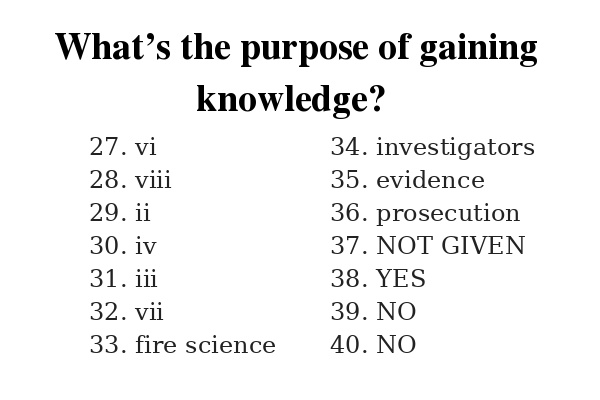
CAMBRIDGE IELTS 12 – TEST 5 – PASSAGE 3 KEYWORDS TABLE
Cambridge ielts 1-18 reading test solutions


Ielts
good
Their explanations are really articulate and accessible. I can see myself making good use of this website to further improve my reading skills! Definitely recommend.